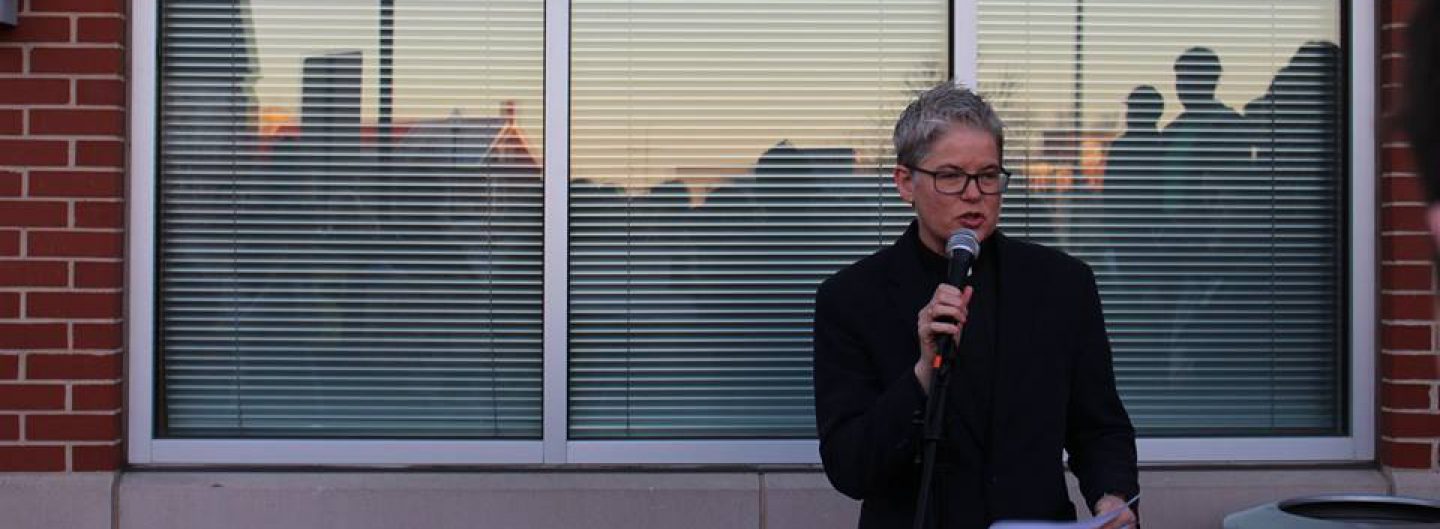
“Your People Are My People”

MCCNY
June 21, 2026

Then they came to Jerusalem. And he entered the temple and began to drive out those who were selling and those who were buying in the temple, and he overturned the tables of the money-changers and the seats of those who sold doves; and he would not allow anyone to carry anything through the temple. He was teaching and saying, ‘Is it not written, “My house shall be called a house of prayer for all the nations. But you have made it a den of robbers.’And when the chief priests and the scribes heard it, they kept looking for a way to kill him; for they were afraid of him, because the whole crowd was spellbound by his teaching.

We’re going to spend more time talking about Holy Week this morning than anyone expected and probably wants. I know it’s Stonewall Sunday and Pride month; I know very well that we need affirmation and confirmation and Pride. Let’s get some of that going: We belong. I’m so glad I don’t belong, I’m so proud to be in this society. You’re beautiful. You are already enough. I love you.

Now bear with me, please; it’s going to be rough for a few minutes.

I want to paint a picture of the first-century, Roman-occupied Passover celebration in Jerusalem. Ironically or tragically, “They were celebrating divine deliverance from past Egyptian imperial bondage while under present Roman imperial bondage.” Think about that for a moment, and also our celebrations of Pride lately maybe always. They were celebrating deliverance from oppression while under oppression. My boyfriend John Crossan describes the Passover festivals as clusters of high tension, thick with the awareness of surrounding soldiers posted around the Temple perimeter on the ramparts. Because Passover was a revolutionary event, its festivals were often flashpoints of dissent, some of which became riots. In 4 BCE Archelaus one unpronounceable Roman general sent his whole army to slaughter about three thousand Jewish rioters during Passover as they made their sacrifices. (This may be what Luke 13 refers to, when Jesus is asked about the Galileans whose blood Pilate mingles with their sacrifices.) In 50 CE, Cumanus another guy I’m not going to try to pronounce his name sent his whole army to trample and slaughter ten or twenty thousand Passover rioters. Everyone there today knew the revolutionary import of the festival. Everyone there today knew why the soldiers were there and why they made themselves visible and how eager they were to quickly and cruelly give punishment on a moment’s notice. This is the Jerusalem Temple that Jesus entered and started throwing stuff around. Hi.

Trigger warning for this next bit. I want to paint a picture of crucifixion: a form of execution that was designed to start by carefully balancing enough brutal beating to reduce physical resistance but keep the target still-alive enough to experience a very long and tortured death suspended on a pole. They were publicly flogged, publicly marched, publicly displayed on a pole. It was public to warn everyone: Try me; this could be you. It was public to humiliate and dishonor a person and their family. It specifically and notedly was public to dehumanize and eradicate a person: their body was left unburied, hanging, to be eaten by birds and dogs and to be broken down by sun and wind. Like roadkill. Like nothing. The remains of one single person has been recovered in all of history of all of the people that Rome tortured and executed in this way. This cruelty is the well-understood and expected punishment faced by people who threw stuff around anywhere in Roman-occupied Jerusalem when Jesus entered the Jerusalem Temple and started throwing stuff around. Hi.

So, yeah. Sorry, but obviously not. So many of these details are omitted from the gospel texts, probably maybe because people just knew the context. Like if we started explaining to each other here in this room right now how we weren’t able to marry for the first thirty or fifty years of our lives and brought a fake date to family weddings and reunions to avoid getting questions and side-eye and disowned. Maybe we don’t talk about it, though, because we like to make things easier on us. Cheap grace. Either way, we aren’t very prepared to hear and understand the importance of these harrowing details. And so Jesus’s crucifixion is most often sentimentalized and spiritualized and made abstract and easy and in the future and ridiculous.

I want us to know that Jesus knew what to expect when he entered the Temple to kick stuff over. Hey. Happy Pride; stay with me, we’ll get there.

This is the stuff, his version of it is what Jesus knew, what he knew-knew, when he entered the Jerusalem Temple and started making a ruckus. The next surprise-maybe, maybe-bombshell is that he wasn’t attacking the Temple or the sacrifices or the priests or the people exchanging graven-image money for not-graven-image money or the soldiers (that was yesterday with the palms) or the state (yesterday) or the supreme commander acting like God (also yesterday). He was criticizing us. He was criticizing us. Us. Good us, religious us, gay us. Us in the seats today. Us on the float next week. He wanted our attention: he wanted more from us.

When Jesus started knocking things over in the Temple that day, he was holding hands across the capital building doors, he was laying down in from of the county courthouse, he was throwing red paint on the draft office. He was symbolically shutting down the shop. No business as usual. That’s probably part of why folks have assumed he was criticizing the Temple or its ritual system, but probably not entirely because also lots of people are just anti-semitic and Christian supercessionist turds. But Jesus was keeping us from business as usual, from ritual as usual. He was yelling some stuff that clarifies what this was all about; John says he yelled something a little different than what Mark says he said, but they work similarly more or less. In Mark, he quotes Jeremiah 7: “Is it not written, ‘My house shall be called a house of prayer for all the nations’? but you have made it a den of robbers” and it meant, hey parishioners, God’s house is to be the hub of diversity, equity, and social inclusion and we’re not doing that, but we have an “All are welcome here” graphic on the church bulletin and it’s not enough. It meant, hey congregants, God’s house is supposed to feed people and clothe people and we’re not doing that, but we include a prayer for those folks before communion and it’s not enough. He’s saying it’s not enough to do the ritual acts that represent our connection: the annual dues, the animal sacrifice, attendance at service, weekly communion, the Pride parade or even the Dyke March (better, the Dyke March is better). It’s not enough to do the rituals that symbolize our belief in connection, we must do the behaviors that create and sustain real connection and real enoughness and more safety and more wellness. And if we don’t do that relationship work, that justice work, if we only do the ritual stuff and attendance stuff and even donation stuff (keep doing the donation stuff), then we are using church or ritual or Pride as cover, as Performative Goodness, as our beard.

In Jeremiah 7, the people chant, “This is the temple of the Lord temple of the Lord temple of the Lord” and do nothing to rescue the oppressed, defend the orphan, plead for the widow. I’m not accusing anyone here of defrauding vulnerable people or exploiting labor. And. But, if we aren’t taking action to defend and restore dignity and autonomy to trans folk being erased and exposed, God doesn’t want to hear our love is love, gay is good, God made me queer chants. God definitely wants to hear our love is love, gay is good, God made me queer chants. So do I. I definitely want to live in world where the Pittsburgh Pirates and LA Dodgers rainbowtize their logos. I feel seen and stuff. And. But, worship does not excuse us from making justice. Being gay does not exempt us from doing Queer.

The beauty of queering the bible has always been naming characters like Deborah, Jonathan and David, Ruth and Naomi, the Ethiopian eunuch, Lydia, and that lesbian power-couple house-church leaders. The beauty of studying queer theology and queer bible study is finding ourselves not just always having been around (we’ve always been around), not just included in the story and participating in the history of being and making lasting faith communities, but the beauty of it is how many of us in the canon are exemplars, are models, are revered kings and judges and embodiments of the creating and sustaining relationship that drives and defines our faith.

We think of Ruth and Naomi as gay ladies gaying up the bible, but hold that thought for a second. Happy Pride. Love you; Jesus wants more from us. The book of Ruth is read at the festival of Shavuot, which celebrates the giving of Torah. It’s not history, probs; she probably wasn’t a historical person probably definitely. And her importance as a parable isn’t as the great- great- whatever- grandmother of David, but more the opposite, like probably David is named as her heir because she is so important. Naming him lends him some of her riz. She exists, the parable exists, to embody chesed, which is central to Torah, to Jewish faithfulness and obedience. It’s not easily defined, and I don’t presume to define it for Judaism, and it’s something that is expressed in her vow to Naomi: I will not abandon you; your people will be my people, spoken by someone who was not of Naomi’s people, and in fact was disliked or even despised by Naomi’s people. Chesed encompasses steadfast love and covenant loyalty; it inspires grace, mercy, kindness, and generosity to others. We understand it in many ways colored by things Jesus said and did, like the shared meal, like give away everything you have to people who can’t pay you back, maybe especially things like love your enemies.

Were they gay? Who cares. Two women don’t have to feel hubba hubba in order to express love and loyalty, or to commit to lifelong mutual aid. The emotional intimacy and interdependence Ruth expresses here is part of what we know to be our queer family, our friends’ chosen family. It’s not about sexuality; it’s not limited to queer sexuality or queer people. This book is read at the festival of Shavuot, for Pete’s sake, to represent a central quality of Jewish faith for all.

Were they gay? You bet your sweet rear end they were gay. Prove they weren’t. I can’t count how many mainline professors and colleagues and seminarians over the years have pooh-poohed to me the queerness of this relationship, with zero persuasiveness. It’s right up there with the number of women who live together for “safety” or “to share expenses.” It’s up there with the number of times people asked if Corrine and I were siblings. These two fictional nonhistorical characters in a book-length parable analogizing a crucial divine quality are as gay as a Barry Manilow cabaret in a Dolly Parton bathhouse. In Chelsea. Who cares? Why does anyone care so much about them being queer that they need to say they weren’t? Go sit down and hush. God wants them to be gay; prove me wrong.

But the important thing isn’t their sexuality. Well, the most important thing isn’t that. Mhmm, there are other important things. Jokes aside, traditionally, Ruth is the model of a Torah centerpiece of grace, mercy, kindness, and generosity to others by a disliked outsider. Please listen: this is what Jesus went into that Temple in that Roman-occupied state and made that seditious ruckus to tell us to be. They killed him for inciting us to lovingkindness. They tortured and executed him for conspiring to criminal generosity.

Jesus went, Jesus himself went deliberately and strategically to a known certain and terrible death in order to make sure we get the message to be like a disliked lesbian foreign stranger. Listen, will you? Jesus went open-eyed into arrest and public beating and prolonged suffering and death to tell us that God wants more from us than perfect attendance and Protect the Dolls t-shirts.

God wants us all to wear Protect the Dolls t-shirts.

Growing up, my weird fundamentalist end-times-loving church used to ask us, if we were arrested for being a Christian, would there be enough evidence to convict? Nevermind their definition of Christian is more or less what Jesus is throwing chairs and chickens at today, but still they’re onto something. If we were arrested for being anti-racist, if we were arrested for aiding and abetting trans health and wellness, if we were arrested for empowering and equipping women and Black women and trans women, if we were arrested for harboring immigrants and promoting the welfare of Palestinian people and impeding the carceral state, would there be enough evidence?

We’re all thrilled that a rugby player was able to come out this week in a sport it’s hard even to be a regular manly man in. Happy Pride. Jesus loves you and stuff, a lot. And he wants more from us. Jesus staged a treasonous pre-riot in front of Roman sentinels and within a week was state-murdered for it to tell us he expects more than rainbow bunting and credal recitation.

If we are not a working class fat Black trans lesbian who uses mobility support, and so few of us are, and if we’re not then it’s going to take a bit more intentional, thoughtful work to live out the justice we’re being called to by today’s Jesus. We’ll need to work at it. Jesus wants us to work at it. I understand if gay men and lesbians are worried about someone coming for marriage down the road, even soon. That’s a real possibility. But they’ve already come for trans existence. It’s already happened. Our sense of self, mobility in this country and international travel, use of public spaces, participation in sports and armed service and tracking us through medical records and whatever else. Your people shall be my people. I get it if we’re starting to worry about custody of our kids again, and access to family insurance. That’s a valid fear. But they are already withdrawing trans healthcare and wresting trans kids from their parents’ custody decisions. It has already happened. And Black folks have never been safe in this country, not ever. Not ever. Your people shall be my people.

I think it was Malcolm X and, more recently, activist and scholar Mica McGriggs who highlight the intersectional litmus test for broad safety, and how the structural and social changes made to protect the most vulnerable intrinsically protect everyone else. If we are not the human embodiment of the most vulnerable, and if we give a shake about what Jesus said, and if we don’t want to use our faith and our Pride as cover, we must think beyond our own, personal priorities for safety and well-being and what’s “enough.”

Your people shall be my people: it will take effort and consideration for those of us who are not being harmed to chesed for the other. It’s not just a good goal; it’s the center of our faith. I’m arguing today that it’s what Jesus died for. I’m arguing this morning that caring about and risking ourselves for the people we are not is specifically and deliberately what Jesus died to make sure we know is expected.

That’s it. I love you. Happy Pride, let’s get to it.

Is This a Pride Sermon or, Pride is a Verb

MCCNY
June 22, 2025

Ezekiel 16:48-50
Mark 11:15-19

I want to start by reminding us of the Ezekial passage just now. Here’s what it says again: As I live, says God, your brother Sodom and his sons (I’m not having that misogyny nonsense today on top of everything else; live with it) your brother Sodom and his kids have not done as you and your children have done. This was the guilt of Sodom: they were arrogant. They had abundance and easy prosperity, but they did not empower the poor and needy and make them strong. That’s what the word means translated by so many bibles as “help.” It’s not alms or pity help or white saviorism. It’s not condescending or even genuine, generous condescending. They had abundance and easy prosperity, but they did not empower the poor and needy and make them strong. They were arrogant and did not abide by my laws. So I removed them.

God said that. Hold that thought.

I’m tired and out of sorts. I may never have needed to swear in a sermon more than I need to swear in a sermon this week. I feel like I’m living in The Running Man, and not in a good way. If you don’t know the reference, shame on you. It’s peak Richard Dawson.

Today is Stonewall Sunday. Next Sunday is the 56th anniversary of the Stonewall riot. June has for decades been committed to Pride emerging and exposing itself, sometimes literally, in marches and parades and corporate pretendo allyship shilling for queer and genderqueer dollars. Over time, we got safer. We did more parades and fewer marches. Maybe we got comfortable. Maybe we started to think we were post-queer.

This year, this month, they’ve undone the name of the U.S. Navy Ship Harvey Milk, named for a queer, executed city council member and national pro-gay activist. They’ve redone the names of confederate forts Pickett, Hill, and Lee that we’d changed because those guys were traitors and they were committed to preserving human trafficking and enslavement. They decommissioned the suicide hotline dedicated for queer and genderqueer callers; and people will die. When they did it, they removed the T from the acronym, our acronym – our acronym! I have such mixed feelings about our acronym and the conflation of sexuality and gender and the bogus false inclusion of trans folks in name only and the weird way the full acronym is used as an adjective. Like how a February NYT headline reads “Nearly one in ten adults identifies as LGBTQ.” I doubt that very much. I’d be surprised if a single adult anywhere identifies as “LGBTQ.” The bland thoughtless use of those letters makes me nuts the way some people get worked up about the Oxford comma. Okay, I’m one of those people, too. It’s a frustrating acronym, but it’s our acronym. *Our problematic friend. And we, we will decide who will and won’t be bogus false included in name only.

This month a Minnesota state senator was assassinated, her husband murdered, another senator and his wife shot, their families threatened in their homes. Violent murder in their homes and a two-day killer at large in the state, but Minnesota was mocked and its representatives mocked and blamed and laughed at like they were women disclosing rape in the 90s.

The Supreme Court this week affirmed a state’s right to deny harmless, reversible, best practice, science-driven gender-affirming healthcare wanted and needed by some trans kids *and their parents, with their parents’ permission, and people will die. The House made deep cuts to Medicaid and they’ve shut down AIDS and cancer and other disease research and vaccination, and people will die. They’re supporting a war against starving children. They’re supporting a war against people defending their own national sovereignty. They’ve started yet another war over control of middle east wealth and assets, and people will die.

What’s the sin of your brother Sodom? This is it, these are Sodom’s sins. Arrogance, abundance, and not sharing. Not resourcing and building up folks who are sick, disempowered, who don’t have enough. It’s here, it’s happening right now. I could really use some Sodom-era divine justice fire and brimstone. I don’t even believe in hell, but I could use some of that OG retribution right now. Not drowning the whole world or burning a whole city; I’m with Abraham on that, but certainly let’s have some Reed Sea close over some selective cohorts after the good guys have passed through. Definitely let’s have some zapping like God did at those two guys trying to catch the ark from tipping over.

Seems like if two guys can get zapped for trying to keep the sacred ark from falling over and getting busted, there could be a lot more zapping right now for all the deeply on-purpose evil acts against the sick and poor and disempowered. I’d like to see a large number of pillars of salt that used to be all these people looking backward and longing for the old days of enslavement and klan rule and trans erasure and mediocre white men in charge. I’d be cool. A little casting into outer darkness and gnashing teeth. Where’s Armageddon when you need it.

I’m joking.

I’m not joking.

Where’s divine justice.

Where is it.

This next sentence is going to feel obvious. I don’t want this to be a feel good sermon,  and not just because of naming all the evil in the country this month, this year. I don’t want us to leave here feeling good about ourselves. I don’t want us to leave here feeling Pride month proud. I don’t want us to leave feeling good enough.

Please stay with me on this; I love us. I love you.

We aren’t bad; we aren’t bad. And we’ve got to move past encouraging and feeling good about ourselves for not being bad. I love us. I love you so much; we are existentially good. And we have got to move beyond affirming our existential goodness. Yes yes yes, Sodom wasn’t torched, even in the parables, even in the fables, Sodom wasn’t torched for being homo.sexual. Those guys raped and broke faith with a traveler and were treating their own disadvantaged neighbors similarly. We know this, and if anyone here doesn’t know it, please check in with one of us for the bibliography. We aren’t bad, Sodom wasn’t gay, God loves us. The end. But not the end. That’s not the goal, it can’t be. Pride isn’t the point.

Pride is the point. Pride is our power, our empowerment. And it’s not the end, it’s just the beginning. We can’t stop there. We can’t just work enough to get ourselves through the door, and then close it behind us. That’s what Jesus is mad about today, it’s what he has advocated and acted against again and again. It’s what he’s demonstrating against today.

I want us to feel strong and empowered. I want us to reject shame and blame. I want us to move through the world heads up, eyes up, shoulders back. I want us to claim our promise, our birthright, claim our goodness and divinity. But that’s just not enough. It’s not enough. I’m not sorry for saying it; Jesus said it.

You are enough. And knowing and living our enoughness is not enough.

We are called to act for justice, for distributive justice. To hold accountable. Anything less is falling short of the glory, baby.

Knowing what racism is and does isn’t enough. We are called to countermand and dismantle it. Knowing what sexual consent is isn’t enough. We must share power and practice consent in all of our interactions with one another, and name it and hold each other accountable when we don’t. And if anyone thinks sharing power is weak or “woke,” I’ve got a donkey-riding king to show you and a messiah who went open-eyed so to speak toward arrest and execution. It’s not enough to know the definitions of colonialism and cultural extraction and mass incarceration. Knowing that homos.exuals and transes are in every era of history and geography, we are, isn’t enough. Knowing that we’re in the bible stories as exemplars and saviors, we are, knowing that we are as holy and wise and righteous as anyone, we are, is not enough. It’s a lot. It’s amazing. I want it for us. And we must go beyond our Pride; we must strengthen and build up the poor and sick and disempowered.

Jesus said it and demands it of us. That’s what’s happening in the temple today. Every gospel has this account of the temple civil disobedience. Any gospel in the canon that isn’t completely made up pairs it with the street action of the palms procession for a two-part indictment. Any gospel in the canon that is completely made up uses the two acts of public civil disobedience at the beginning and the end of Jesus’s ministry to bookend his life and work, to highlight acts of discipleship, of direct action, and its cost. These actions are almost certainly very actually probably why Jesus was executed.

It’s really important to know what he was criticizing. I’m not one hundred percent sure what Jesus is specifically targeting in the temple, but he’s not attacking Jewish faith, or necessarily temple structure or even the high priesthood. Probably yes, though, he may be targeting specific priests and lampooning specific governors and administrators yesterday, and maybe even other messiah types, with the donkey cabaret. I believe he is criticizing current practices, current legislators so to speak, current policies and structures so to speak, associated with the way the temple was currently operating. Who it was serving and who it was taking for granted. That he was highlighting and condemning these people and what they were doing to prop up the *system,” to support and grease the faith machine that “practices faith,” that “has faith” but doesn’t do justice, that “performs faith” and enacts ritual and allows the poor and sick and disempowered to participate but does not “help” them, doesn’t strengthen and build them up. In our own terminology, Jesus is probably definitely criticizing the operation of the church for giving the superficial impression of doing church but not, in fact, doing God’s work.

That’s what he means by quoting “den of thieves” from Jeremiah. The church is the refuge. It’s being used as cover.

Probably the Mark gospel made the house of prayer reference for its own purposes forty years later, but probably historical Jesus quoted Jeremiah. Jeremiah was talking about leaders who robbed or exploited the poor and sick and disempowered and then used the temple as cover. It might be like what the Southern Baptist Convention did, also this month, curse them, and any other body calling for harm and disenfranchisement of queer and trans folks in the guise of religion. It’s not exactly the same, but it’s similar, and people will die. Jeremiah says, your churches are pirates’ lairs. Your churches are bunkers. They are fundamentally rejecting, Jeremiah is, Jesus is, the veneer and machinations of any faith that doesn’t do its work of strengthening and building up the poor, sick, and disempowered. They are saying what Amos (5), and Hosea (6), and Micah (6), and Isaiah (1) all say: Your hands are covered in blood.

This is what I’d like us to think about today, but not as the victims of the violence. Not just as the victims of violence. This is how I’d like us to think of our Pride this year and ever, our church, our streets this year and ever. Not just for us. Not just for homos.exuals and transes. Not as a time and place to bolster ourselves only, to let ourselves through the door just to close it behind us.

That would make us the thing Jesus is condemning and demonstrating against today. To use our Pride, use our faith, use our inclusive churches, use our Pride month as a cover, as a beard, for celebrating ourselves and raising up ourselves and looking good and doing the appearance of justice and equity but not doing the work of justice or equity. The work of empowering the poor and sick and beset upon. We can’t just feel good about being queer and genderqueer. Please stay with me with this; I love us. I love you.

You might be thinking, but we are the beset upon, and we are. But we aren’t a monolith. The Jews under Roman control in the first-century land of Jerusalem were not a monolith. It’s one of the things that bothers me so much about the acronym, *our acronym! and its conflation of sexuality and gender and the bogus false inclusion of trans folks in name only and how people use it. I’m going to just say and hope we can acknowledge together that, yes, we are all beset upon, and that trans and genderqueer folks this year especially, this year uniquely, are profoundly experiencing a different level of violence and erasure, legislative and communal, in sport and healthcare, in identification documents and how that affects us moving in and between public spaces. That the numbers of our Black and brown trans sisters have never gone down, not once, at Transgender Day of Remembrance.

I hope we can acknowledge together that the newish anxiety and fear in this country of authoritarianism, or fascism, or totalitarianism or whatever words you’re using is not new or newish to our Black family and neighbors, that these or similar terms generally and broadly could be described as Black experience in this country always. Always. That our Latine family and neighbors are being literally hunted, literally hunted in their homes and cars and workplaces, hunted in the courts and offices needed to conduct their legal pleas for residency.

There aren’t sides. No things are a monolith. It’s not enough to be indignant. It’s not enough to be indignant about what the “other side” is doing and be proud of not being Them. It’s not enough to know what’s wrong, and it’s not enough to be in another political party than the one doing the deeds. There are people doing terrible, violent things. There are people aiding that harm, or looking the other way. There are people interrupting and shutting down business as usual, throwing blood on the draft files. And all those people are all along the political spectrum. This isn’t about being registered Democrat any more than being anti-racist means just not being klan.

I am so resistant to saying any generous thing about Liz Cheney, who voted something like 96- or 98% in line with her party eight years ago. But she is entered into evidence that they aren’t a monolith. Blue politician Gavin Newsom is defending his handily blue state from legislative and economic attacks, and he is beleaguered, and – and I still remember this – last year he said transgender lives and rights were expendable and should be sacrificed for his party success.

There aren’t always sides. There aren’t monoliths. Last Wednesday, Nezza sang the pre-game anthem at Dodger Stadium in Spanish para su gente, even though the Dodgers club administration said sing it in English. And some Dodger fans called for a boycott, and someone from the Dodger club maybe told Nezza she wasn’t welcome back. But Puerto Rican baseballer Kik3 Hernandez, Dodger utility player and currently in a bit of a batting slump, had posted to Instagram last weekend that he “cannot stand our community being violated,” and is “saddened and infuriated by what’s happening in our country and our city.” And yesterday those of us who get NYT notifications on our phones about the LA Dodgers got one that the Dodgers administration closed its parking lot to ICE agents and announced it is fronting $1 million and partnering with the California Community Foundation, the Los Angeles County Federation of Labor, and other organizations to continue providing aid to immigrant families.

I don’t want us to leave here today feeling good about ourselves. I’m worried when I preach about our responsibility how many folks afterward seem to keep only hearing me say that whatever you do is fine. Whatever you do isn’t fine.

Whatever you do is fine. If you do something. Whatever you do is fine if you do something. It’s not me saying it; it’s Jesus. If the church isn’t doing God’s work, shut it down. If Pride isn’t doing Justice’s work, it’s not enough, shut it down. Do something. There is plenty, large and small, something for everyone. Some people turn over the moneychanger’s tables and get executed. Some people go around the corner and untie the donkey and the colt of a donkey. (Just kidding, there was only one donkey.) Nezza sang in Spanish para su gente even though she was scared. Safeway workers are striking. Millions of people protested and marched and put their bodies in danger for No Kings. The NAACP won’t invite a sitting president to its national convention this year for the first time ever in its 116 years. That Swedish kid that rode in a boat to the climate summit rode in a boat to Gaza with food and medicine. Boston has declared itself a sanctuary for immigrants and trans folks. People donate to the ACLU and Lambda and The Abortion Project.

There is a lot to do, different kinds of things to do, and it is not enough to perform faith, or Pride. We have got to do the work. Jesus said so; he said it, not me. He said, you have to do something. Jesus didn’t die for us so we don’t have to; someone else told us that. Someone who wanted us to sit down and look away. Jesus said I’m going to do stuff they’ll kill me for; follow me. And in case we spiritualized that, like how we did for hundreds of years, he said, Take up your cross and follow me. We still spiritualize it.

I love you, Compton people. Folsom Street people, I love you, Stonewall people. I love us. You’re good; you’re so good. Happy Pride, family; Let’s get to work.

Peace.

There’s Still My Joy

MCCNY
December 17, 2023

The spirit of God is upon me, because God has anointed me; God has sent me to bring good news to the oppressed, to bind up the brokenhearted, to proclaim liberty to the captives, and release to the prisoners; to proclaim the year of God’s favor, and the day of vengeance of our God; to comfort all who mourn; For I, God, love justice, I hate robbery and wrongdoing; I will faithfully give them their recompense, and I will make an everlasting covenant with them. Their descendants shall be known among the nations, and their offspring among the peoples; all who see them shall acknowledge that they are a people whom God has blessed.

Greetings and blessings from the Council of Elders.

I have been thinking for a while about joy and what it is and whether I have any, and I need to be honest and warn you that today will be a struggle, mostly for me but also for you all, given that it’s Advent Three: Joy Candle Week and given that, on a basic level, I am constitutionally suspicious of joy. Joy is one of those things, like forgiveness, that people seem to talk about with a lot of certainty and confidence, like it’s inevitable or even fathomable; people telling us that we should have it and when, and what it does and how it feels. And to smile more.

We’re told I think that joy is a synonym for happiness, for example, or as extremely deep happy-ness, but we’re not really taught about how it’s different from being happy. We’re told to think of this season as intrinsically joyful and happy, we’re practically bullied into it by capitalism and compulsory Christianity. And Joy feels equated with decking halls, for example, or what fun to ride, or ho ho ho, which are all fine things don’t get me wrong. (Though all my favorite hos are homos.) Happiness is lovely. Of course, of course, for pity’s sake. I’m not a grinch. I don’t want to spoil joy. But I don’t want to keep getting battered by it, and I’d like to think about it and appreciate what it is and, maybe more importantly for me, what it’s not.

Because we are living in this terrible time. The October 7 attack of Israel was the biggest escalation since the 1973 Yom Kippur War. More than 100 hostages are still held in Gaza. In the responsive strike against Hamas, Palestinian homes, hospitals, schools have been leveled with the death number at nearly 19 thousand. Without clean water, disease is spreading. Israeli soldiers and, as of yesterday, Israeli hostages are being killed by friendly fire; journalists are being killed in record numbers, I think. In the U.S., anti-semitic attacks have increased 400% since October, but reports in April showed anti-Jewish violence already high from a worldwide spike in 2021 that never ebbed in the States all through last year and this year, including hate crimes and anti-semitic white supremicist propaganda. New York City, our own city, our home, was among the three cities named with record numbers of anti-Jewish hate crimes. And the Council on American-Islamic Relations is receiving double the number of anti-Muslim and anti-Arab reports and requests for help.

Then there’s the Movement Advancement Project, which has mapped that forty-five percent of queers and genderqueers live in the 28 states with low or negative state policy tallies. People are going after trans humans like we’re a threat to democracy. But we’re just doing regular stuff mostly, occasionally using public restrooms, sometimes but actually pretty rarely trying to play some sports, every once in a while hoping to postpone puberty in completely safe and reversible ways.

Last time I was here I mentioned the death rate for people in childbirth has increased for everyone but Black women, and still the mortality rate is most deadly for Black folks in childbirth. That’s not a coincidence. It’s not an accident. That’s the brutally logical result of racism and misogyny and the violence and weathering effect on every person who lives at that intersection.

And I feel like I can’t even scratch the surface of the actual, documented threat to democracy that we are facing and have been facing since we experienced for the first time in our nation’s history a failure to transition power peacefully from one administration to the next. The attack on journalism, on the separation of powers. Or what’s happening with reproductive freedom. A woman in Ohio was told by her doctor in the 21st week of her pregnancy that she may miscarry, and a week later she did. She was on the toilet, miscarried, was taken to the hospital for life-threatening complications. And a police went back to her home, cracked the toilet base to retrieve the fetus, and charged her with desecration of a corpse.

This doesn’t seem joyful. This seems counter-joyful. At odds with joy. It seems anti-joy. But I don’t think it’s inappropriate to attend to these violences and inequities and name them today on Joy Sunday. I feel like if folks don’t know these things are happening, we need to know, and it maybe is of concern that we don’t. And I don’t think it actually is anti-joy or anti-Christmas to hold them and feel deeply their grief and their anger. But I also struggle to *feel joy when I read the news and listen to the news. Except for Jon Lovett. My dudes. If you are struggling to stay connected to what’s happening because it feels like too much, too bad, too draining, may I please just ask-slash-urge you to check out Lovett or Leave It, which is part of the Crooked Media family and is cousins to Pod Save America and Hysteria. It’s a bunch of former Obama White House staff and other people, younger than me, smarter than me, taking on the real mess we’re in with a filter that helps me, at least, feel still able to move and act and laugh and feel.

There may be a tie-in here to the Isaiah text, which also describes oppressed and brokenhearted people and captives. This text describes the return of exiles, coming home to a country that’s been ransacked, a wasted temple, a conquered and subjugated nation. And it talks about moving and feeling and acting. In the same lines and in the same breath that the writer names prisoners and mourning, it also speaks of bringing good news, binding up the broken, and proclaiming liberty.

Of course it is possible to remain connected with joy, in times such as this and while sitting with and naming injustices. Of course it is; but is it, though? I worry about moving too quickly to optimism or positivity. I worry about skipping over the raging wildfire of awful, of minimizing the magnitude of injustice, dismissing it by taking sides or with lemonade or with quick and over-simple platitudes about God’s will and tough love. I worry about compartmentalization and dissociation. It’s more or less our nature, maybe, to want to squirm out of sitting with feelings of sadness and frustration. We are definitely not encouraged or taught how to express a full and complex emotional experience that includes a range of sadness and grief and rage and fear and also a nice selection from the joy family. Something that is joy or akin to joy.

There’s a winter hymn, an Advent hymn, my favorite, that could illustrate this, called In the Bleak Midwinter from a Christina Rossetti poem,

In the bleak midwinter/ Frosty wind made moan/ Earth stood hard as iron/ Water like a stone/ Snow had fallen/ Snow on snow/ Snow on snow/ In the bleak midwinter/ Long, long ago.

It’s describing a winter reality much like earlier cultural constructs of this season, before our current claymation-based marketing strategy: Advent used to be Winter Lent, and it used to be as staid and self-denying and bleak as any other Lent, and maybe more so because it was in the season of darkening and cold-ening rather than in spring. People would fast and pray and repent, and Lutherans would sing especially-tuneless hymns, more than usual. This hymn is brilliantly reflective of the reality of its setting, in these early lyrics and in the key of G-major; it is cold and distant and still warm and intimate: Only his mother/ In her maiden bliss/ Worshiped the beloved/ With a kiss… What can I give him?/ Give him my heart. It is bleak and iron gray and iron hard and also gently and softly joyful.

These scriptures and these hymns are clues, I think, to ways to recognize the pull and the power of joy, even in hard, awful times. That it is not always a victory march, can be a cold and broken halleluiah. Knowing that possibility and complexity I think can make it possible to be more present for our neighbors and comrades who are struggling. Knowing that grief doesn’t have to undermine joy can make it possible, perhaps, to attend to folks who are feeling estranged from community and care, folks who are grieving loss or reliving loneliness while so many others are demonstrably happy, acting like it’s the most wonderful time of the year and vomiting bows and glitter. I wonder, even, if this is exactly why the Liturgical Powers That Be placed Gaudete this late in Advent, in the week closest to the darkest day. Not because joy makes the most sense, but because it makes the least. Not as a mandate or a compulsion, but maybe they and Isaiah and Rossetti and many others are encouraging us to look for and maintain joy as a practice, as a discipline.

Some of the low-hanging fruit, when it comes to joy, is children. The liturgists and lots of people associate joy with children or childlikeness or childish wonder. Gaudete Sunday traditionally includes a blessing of the children, and a lot of the imagery and symbolism of joy, and of Advent joy in particular, is associated with children: Elizabeth’s child leaps within her at Mary’s greeting, Mary’s baby is born with a heavenly proclamation of good news of great joy for all the people, children and vipers play together in peace. I think people find it easier most of the time to talk about ideals like joy in terms of youth and innocence. And I get that. Children can be great. Some of my most uncomplicated joyful memories are of teaching my godson Alfie to ride a bike and giving him piggy-back rides on our way to the park while he narrated his world in my right ear.

But equating joy with children may be, maybe, overly romantic and incomplete. And not just because it used to take Alfie an hour and a half to eat a peanut butter sandwich. Not just because of that relentless snot situation, or watching children eat yogurt from a tube, or the struggle to have a rational conversation. And only partly because of how awful it can feel to be treated as though our families without children are not real families, or that the emotional harm of medical and athletic and legal exclusions to grown trans folks or violence to whole Black adults isn’t worth caring about or organizing around.

Part of the tension, and part of our larger-community interest in queering theology, is to find ways to reframe things that are harder and less idealistic and less common, to face things that feel hard, even when it comes to joy. It seems important and necessary to connect children to struggle, and important to relate our grown-up, imperfect lives to joyfulness and wholeness. It seems important and necessary to know that we are all children, and we are all like children, when it comes to archetypal values like worth and protection and innocence. We are all worthy. We are all precious. We are, Sarah MacLaughlin says and I think she’s solid on this, we are all still innocent. (Yeah, Adia.)

Joy can also, obviously, be felicity. It can be like that magical stuff we call grace, the kind of joy that comes unbidden, or unaccounted for, from no apparent source. That’s Isaiah today again, when through oppression breaks good news, over brokenheartedness comes bolster, against captivity shines liberty. Lots of us have experienced this, I imagine, those moments of incomprehensible peace or unaccountable bliss in the midst of chaos or terror. Something divine not in the devastation but in the healing; something holy not punishing us or testing us or building character but wanting and aching for justice and healing with us.

And joy isn’t always or maybe not even mostly a gift. Understanding joy as a discipline, as a practice, makes us responsible, too, for our joy specifically and more generally accountable for our attitudes and actions. When Isaiah asserts that the spirit of God is upon us, because God has anointed us; God has sent us to bring good news, to bind up, to proclaim liberty and release; to comfort all who mourn it seems both an assurance and a calling. It seems as much a vocation as a promise.

There’s a post-it note I’ve moved into every office I’ve had for the last ten years or so that says “emotions are habits,” I have it tattooed on my arm, to remind me mostly that I can re-learn lessons about anger, and maybe someday also shame, but also that joy isn’t a mystery, that peace isn’t only a product of my circumstances that day, that lovingkindness is almost never something I feel. Joking but also not necessarily joking, you know? Emotions come at us and surprise us, but not only; we don’t have to be and I think mustn’t be at their mercy. We can cultivate them and, at the risk of sounding like I’m telling anyone what to do, we probably should cultivate them. If we wait around until we actually feel like loving people, if we depend entirely on feeling peace or joy or patience or gentleness or self-control… I don’t know. I don’t know. These are awful times, now and throughout our whole lifetimes things are deeply jacked. Maybe peace and joy and patience and gentleness and self-control are also spiritual gifts, but it’s not even just that I think of this stuff as work we have to and *get to participate in, but also that understanding joy exclusively as a spiritual gift makes it deeply implicated in supremacy and hegemony. It makes joy one more thing in a long list of things harder to access for marginalized folks and easier to monopolize and define for privileged folks.

Reframing joy as a discipline is exciting; it’s almost subversion. It’s another way to tear down dominant empire, participate in setting and re-setting value, creating new heavens and new earths where good and nonviolent ways and eternal values set the tone and where *we name and create and broaden the definitions of peace and joy and patience and gentleness and self-control, for ourselves and with one another.

Cultivating a practice of joyfulness transcends circumstances, bad *and good. It allows us to experience and share joy in the midst of all of life, to reject pleasure as the sole determinant of when and where we will feel peaceful and joyful and content. Long live pleasure; baby, please. Nobody is doing away with pleasure. But rejecting pleasure as the force that dictates our actions and emotions? That’s revolutionary.

Imagine practicing a discipline that locates our own joy in other people’s well-being. Both sympathetic joy, celebrating good things that happen to others, and also the kind of joy being described by Isaiah, if I can characterize it as joy: a joy that is instigated by distributive justice and social activism. The Buddhist teacher Sharon Salzberg talks about something very similar when she says that the way to happiness is through kindness. I first learned the lovingkindness meditation from Salzberg, and then from it I *started beginning to learn to try to practice becoming someone who can more often maybe extend warmth and feel connection to more people, including those I feel indifferent toward, those I feel alienated from, those I am actively in conflict with. What I feel when I try to practice mindfulness, the equanimity I experience more often, the presence and connection and *patience and *trust that I feel more strongly more often, is so much of what I understand to be Joy: a joy that isn’t circumstantial or conditional.

And it’s when I feel unskillful, when I feel more anxious, angry, overwhelmed, helpless, when I experience those feelings more strongly more often, it’s then that I self-consciously, intentionally seek out and re-invest in mindfulness.

Look, I’m not telling you all what to do or anything. But tai chi first saved my life and then helped me live it more fully. So, you know, do what you want. You know. Don’t learn tai chi and have a better life. I’m not the boss of you.

This is subversive love as resistance as joy. Jesus said it about turning the other cheek, he said love your enemies, love those who hate you and revile you. Jesus said love extravagantly, like it rains, ridiculously, willy nilly, on the good and bad alike. Joy is exactly like that. An internal practice, a discipline free of what good or horrifying things are happening around us. It does help us to experience joy even when the world is on fire. But maybe more importantly, maybe most importantly, it keeps us from glossing over pain and injustice, and allows us to experience a kind of joy that still also attends to and engages with and feels deeply about a world that is on fire. And salves and feeds us to hope for and make change.

Peace.